Weaponizing the FCC
How Progressives Created the Tools of Their Own Oppression

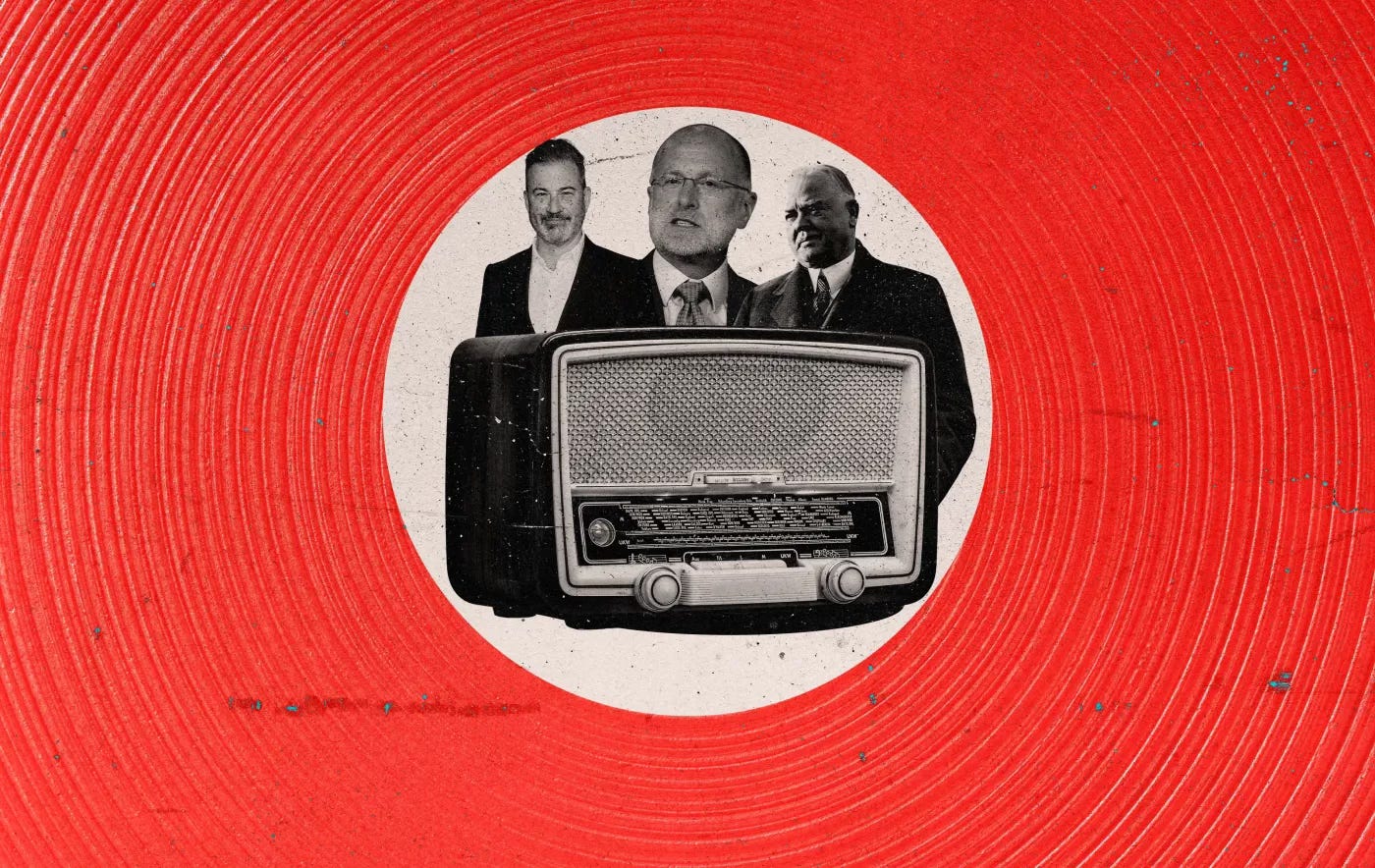
I have a new piece over at the Dispatch discussing the historical precedents for the Trump administration’s weaponization of Federal Communications Commission regulations. I won’t rehash that piece here — though please do click through for a fuller discussion of the news distortion rule and public interest standard — but I have a few additional thoughts for my newsletter readers about l’affair de Kimmel.
This is the kind of scenario I warned about a month prior to the election. At the time, presumptive FCC Chairman Brendan Carr had made it clear that, if Trump won, he intended to find some kind of regulatory hook or legal fiction that he could wield to protect conservative political speech from what he believed to be rampant viewpoint discrimination. As it turns out, Carr has used different tools from what he proposed in his essay for Project 2025; instead of making a Section 230 play and claiming a novel interpretative authority over the state for the FCC, Carr turned to existing rules.
He’s taken advantage of the FCC’s oversight over broadcast license transfers, which has morphed into a quasi-antitrust merger review power, albeit one that is vastly less transparent than the antitrust process at the FTC. Carr then pairs that stick with a justification dredged up from the FCC’s odds-and-ends drawer filled with dusty, historical regulations — ie, news distortion, equal time, public interest — and threatens broadcasters that criticize the Trump administration with unspecified enforcement.
The end result is what already amounts to the clearest episode of government censorship in broadcasting of the 21st century, but it’s the baldness of the censorship that stands out to me. Prior censorship campaigns, like the Kennedy administration’s Fairness Doctrine crusade, had far greater impact, but they also attempted to hide their true goals and methods. I had to uncover that story through a huge amount of archival digging, including finding a smoking gun in the form of an Oval Office tape recording. But the Trump administration’s censorship campaign is happening right out in the open; he’s even bragging about it on social media!
Some of those who read my article mistakenly thought my goal was “whataboutism,” an effort to shift blame from the Trump administration to past progressives. But that couldn’t be further from my intent. I hope that by highlighting the rampant, century-long, bi-partisan abuse of the FCC’s various public interest regulations, it will build broad, cross-ideological support for durable reform of the agency. The Radio Act that established the federal broadcast regulation system was passed in 1927, nearly a hundred years ago. It’s time for a new Communications Act that creates a truly independent, technically-efficient, speech-respecting FCC for the next hundred years.
If you want to read more from me about the FCC and its history of partisan abuse, here are a few additional options:
JFK’s Weaponization of the Fairness Doctrine in the 1960s. (Oxford)
How the “public interest” serves the powerful. (New Atlantis)
Why it’s a mistake to try and apply broadcast regulation to the internet. (Knight)
Brendan Carr is who we thought he was. (UnPopulist)